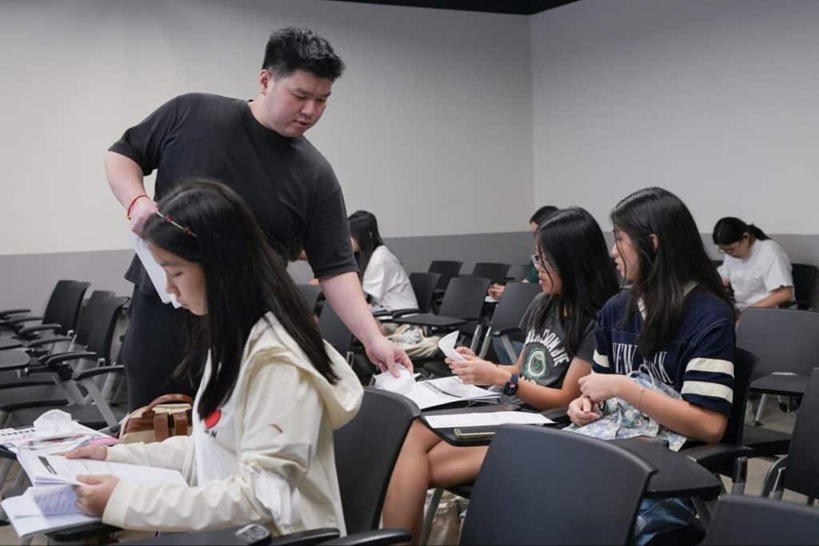
When students and parents begin searching for ip maths tuition singapore, they enter a landscape that differs markedly from conventional academic support. The Integrated Programme, with its accelerated pace and elevated expectations, represents a distinct educational trajectory in Singapore, one that bypasses O-Levels entirely and plunges students into material that would challenge many undergraduates. The mathematics component, in particular, presents challenges that catch even capable students off guard.
Consider what happens in a typical IP mathematics classroom. Students encounter calculus concepts in Secondary Two that their peers in the Express stream will not meet until Junior College. They grapple with abstract algebra, complex numbers, and mathematical proofs whilst simultaneously managing multiple other accelerated subjects. The pace feels relentless, the content unforgiving.
The IP Mathematics Difference
To understand why specialised tuition for IP mathematics has become increasingly sought after, one must first grasp what distinguishes IP maths from standard curricula. The Integrated Programme compresses six years of secondary and pre-university education into a seamless continuum, eliminating the pause that O-Level examinations typically provide.
This acceleration comes with consequences. Topics that would ordinarily be introduced gradually across multiple years arrive in rapid succession. Students must develop mathematical maturity quickly, moving from concrete arithmetic thinking to abstract mathematical reasoning in what feels like an instant.
“The IP mathematics syllabus assumes students can handle ambiguity and complexity,” explains a tutor who has taught both IP and mainstream students for fifteen years. “We are not just teaching them to solve problems. We are teaching them to think like mathematicians.”
This distinction matters enormously. Where mainstream mathematics often emphasises technique and application, IP mathematics demands deeper conceptual understanding. Students must grasp why methods work, not merely how to execute them.
Why Students Seek Additional Support
Despite being selected for the Integrated Programme based on academic strength, many students find themselves struggling with IP mathematics. The reasons prove varied and often interconnected.
Common challenges include:
• Insufficient foundation from primary school for the accelerated pace
• Difficulty transitioning from computational to proof-based mathematics
• Large class sizes that limit individual attention even in prestigious schools
• Gaps in understanding that compound as new topics build on previous material
• Time management struggles when balancing multiple demanding subjects
• Limited practice with the types of questions unique to IP assessments
The students who seek IP maths tuition in Singapore are not necessarily weak students. Often, they are high achievers accustomed to excelling who suddenly find themselves merely surviving. This shift can prove psychologically challenging, making external support valuable not just academically but emotionally.
What Effective IP Tuition Offers
Quality tuition programmes for IP mathematics recognise that these students require something different from standard enrichment. The best tutors possess deep mathematical knowledge themselves, often holding advanced degrees or having competed in mathematical olympiads.
Effective IP maths tuition typically provides:
• Targeted remediation of foundational gaps that impede progress
• Advanced problem-solving techniques appropriate for IP-level assessments
• Exposure to proof-writing and mathematical reasoning skills
• Practice with school-specific materials and past examination papers
• Small group or individual instruction that allows personalised attention
• Connections between disparate topics that illuminate underlying mathematical structures
Perhaps most importantly, skilled tutors help students develop mathematical independence. Rather than creating dependency through rote teaching, they guide students toward understanding how to approach unfamiliar problems, how to verify their own work, and how to learn from mistakes.
The Accelerated Curriculum Reality
Walking through the IP mathematics syllabus reveals its ambition. Secondary One students encounter algebraic manipulation at levels that challenge many adults. By Secondary Two, they are differentiating and integrating functions. Secondary Three introduces vectors, complex numbers, and sequences.
“What strikes me most about IP students is not that they struggle, but that so many manage to keep pace,” observes an educator familiar with multiple IP programmes. “The curriculum makes enormous cognitive demands. Some difficulty is not just normal but expected.”
This perspective helps contextualise the search for tuition. Seeking support does not indicate failure but rather recognition of the programme’s intensity. Even capable students benefit from additional scaffolding when navigating such compressed timelines.
School Variation Matters
Not all IP programmes follow identical curricula. Different schools adopt different approaches, use different textbooks, and assess students differently. Some lean heavily toward pure mathematics, whilst others emphasise applications.
This variation complicates the search for appropriate IP maths tuition in Singapore. Parents and students must find tutors familiar with their specific school’s approach and expectations. A tutor excellent for one IP programme may prove less effective for another simply because of curricular differences.
Many experienced tutors specialise in particular schools or groups of schools, having accumulated years of materials and insights specific to those programmes. This specialisation allows them to anticipate challenges students will face and prepare them accordingly.
Beyond Examinations
Whilst examination performance matters, particularly for progression and scholarship opportunities, effective IP mathematics tuition should cultivate something more enduring. The habits of mind developed through wrestling with challenging mathematics, the persistence required to solve difficult problems, the satisfaction of achieving genuine understanding rather than superficial competence all extend beyond school.
Students who emerge from the IP successfully often describe developing intellectual confidence that serves them throughout university and professional life. They have learned to handle complexity, to think systematically, and to persevere when initial approaches fail.
Making the Decision
Deciding whether to pursue additional support requires honest assessment. Is the student genuinely struggling to understand concepts, or simply adjusting to higher expectations? Are there specific topics causing difficulty, or is the overall pace overwhelming?
For many families navigating the demanding terrain of the Integrated Programme, finding the right ip maths tuition singapore becomes an essential part of ensuring not just academic survival but genuine mathematical growth and understanding.
 Education blog
Leave a comment